
Happiness
I thought I had left everything behind. I hadn’t.

After a hundred and twenty days of solitude, everything was a gift.
First, I got a phone.
Next they tarmacked the road and made plans for a motorway.
Then a mini market and café opened only a thousand steps from our door.
I gained a husband. Luís, by my side. Holding my hand.
Then a car, a job and an identity.
Then we got a supermarket. A proper supermarket that sold a variety of everything. Of course I noticed the biscuits first. Not just Maria biscuits anymore. Breakfast cereals, bread, sauces, frozen food. Even a version of Worcestershire sauce called molho inglês. It wasn’t quite the same, but still.
New buildings were mushrooming everywhere. The skyline was dotted with cranes, and we had new neighbours. We began to think about buying a place in the town centre.
Catherine slept better at night.
I could speak Portuguese.
Even Maria Beatriz had finally got a pension, over fifteen years after her husband was killed on active duty in Africa.
And I made friends.
Cousin Guida was the first. The longest, the best, the closest. She wasn’t, after all, the flibbertigibbet I’d taken her for, but a kind and supportive soul.
A few neighbours. Some colleagues at work in Porto.
One day, an English lady my mother’s age phoned from Porto. She was friends with a colleague of Luís’, and had been born in Portugal. Soon, I was having regular lunches with her and was invited to her ladies’ luncheons in Gaia. There, I met Julia, who introduced me to Emily, who introduced me to Clare.
Happiness.
Even the airport in Porto was no longer a shack in a field.
But.
I longed to jump on the plane and visit my friends and family. I still missed my English life in a way that ached to my bones.
“Why don’t you do a training course with me?” Luís suggested. “It’s about dynamic relaxation.”
“I bet they just sit around and breathe” I huffed. And I dreamed about a room of silent people lying on the floor, breathing loudly, stale breath filling the air.
But I went. A trip to the city. Cars, buildings and people were my native habitat.
Doctor Amélia sat in front, with a projector, and showed how negative thoughts settle into the body and feed back into the mind unless we interrupt them.
My throat tightened.
She wrote on the board.
Sophrology.
sôs (σῶς) → harmony
phrēn (φρήν) → mind
logos (λόγος) → knowledge.
And we started breathing.
Breathing from the diaphragm? Nothing new. My grandmother taught me how to do that to sing.
Focus on relaxing?
And I was in a room of silent people lying on the floor, breathing loudly, stale breath filling the air. And feet.
My throat was still tight, like my breath might be cut off.
Doctor Amélia smiled when I told her. “Não te preocupes. Vai passar.”
The next time, we sat and breathed. We tensed our muscles and breathed. We closed our eyes and moved our limbs, and breathed.
I opened my eyes. My limbs weren’t exactly where I thought they would be.
I put my hands to my throat.
Breathe deeply- tense everything- relax. Breathe. Breathe.
Focus on an object of nature.
A bird? A bird.
And… breathe.
After a few weeks, I could relax, swing my arms with my eyes closed to create my space. Punch invisible problems to make them go away. People, sometimes, but I didn’t say that.
And every time I heard a bird, I relaxed. I forgot about my throat.
It was time to regress.
“Think” Doctor Amélia said “Of a time in your past when you were very happy. As far back as you can go. Look around you. Notice the smells, the colours. Then choose another moment in your life, and another, until you come back to the present day.”
Now… breathe deeply- tense- release- breathe…
I am six years old. It is Easter day, and I am in our long garden with my brothers and sisters, climbing the old oak tree. My brother is halfway up the beech. My sisters playing with the swing hanging from a branch. The sunlight shines through translucent spring leaves. A lark is singing. Robins. Blackbirds. Laughter. My mum is calling us for breakfast. Grandma will be there.
Somehow I missed it, “choose another moment…”
I stayed.
She clapped her hands.
It was 1992 again. I was back in the room in Porto.
She looked around.
“Quem quer falar sobre a sua vivência… Teresa?”
Tears coursed down my cheeks. I opened my mouth, but nothing came out.
That was the beginning.
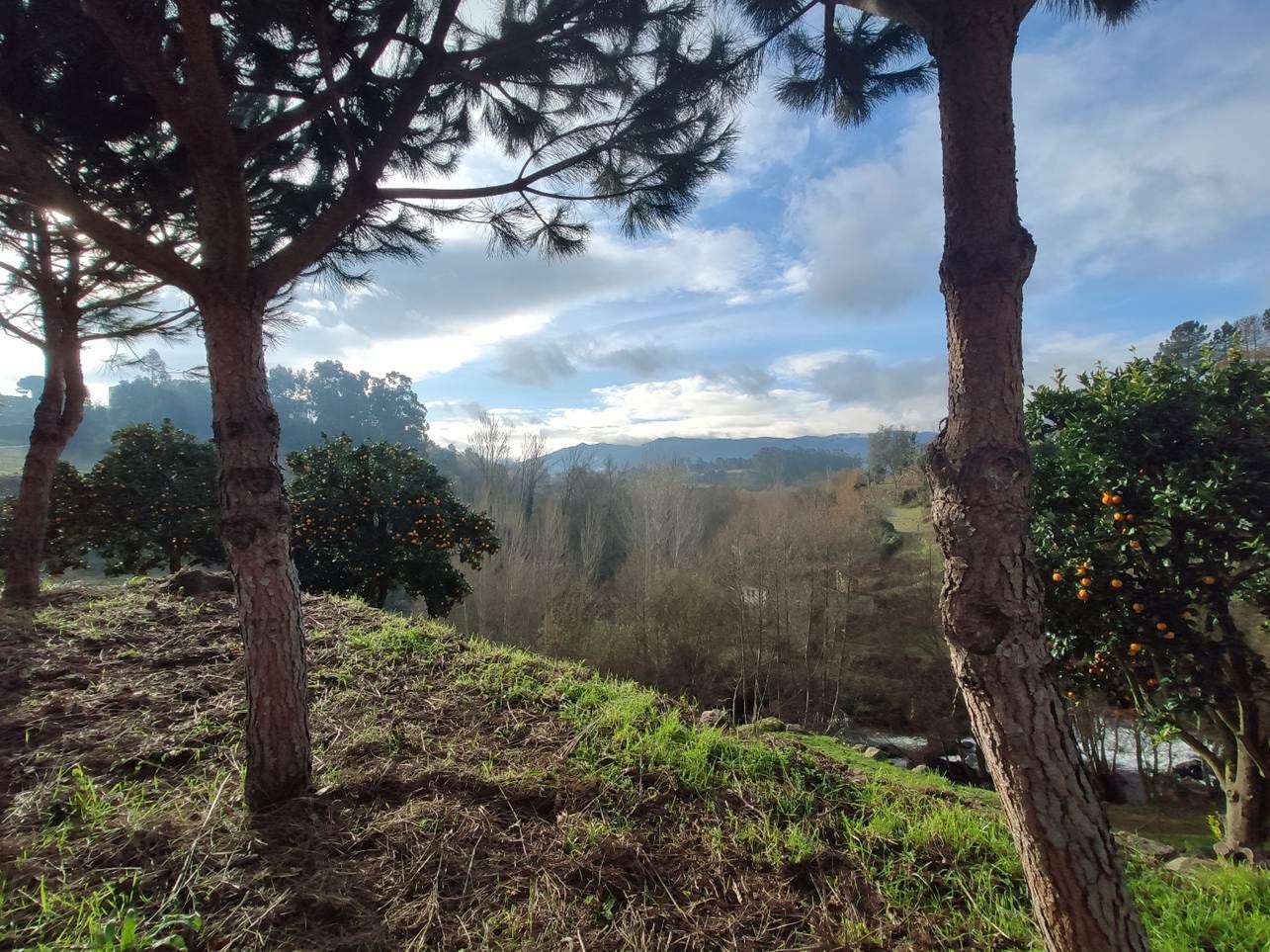
I saw that I was living in a gigantic garden nestled among gently folding hills.
Back at the flat, I closed my eyes, breathed, relaxed. I visited my old house. My siblings. Grandma, smoking, in her lavender-scented house by the sea.
I had lost nothing.
I had gained everything.
Saudades
I was in the Douro again today. It was stunning. The terraces cut into the hillsides, the river held its curve. I could see the beauty without effort.
But I could also feel the history of my body there.
I remembered how hard it was at the beginning. How I missed England with a physical ache. Not only in my chest. In my arms too, as if they had nowhere to reach. It ran through my whole body. It pulled me downward, into the earth, as if the valley could swallow me. My breath would shorten.
I felt myself sinking.
I would look at these deep terraces and see mud. Not vines, not light. Mud, sucking me into oblivion.
I knew, intellectually, that it was beautiful. I could register that fact. But I could not feel it. The beauty stopped at my eyes.
Later, I learned that I had not left my past behind in another country. I carried it with me. England lived in my body. It had not been severed.
Today, standing there, I could feel the whole arc at once. The ache in my arms. The pull in my chest. The shortening breath. But also the ground beneath my feet. The valley did not swallow me. It held me. The landscape has not changed.
What changed was the way I inhabit it
I love that phrase 'The beauty stopped at my eyes' - I know exactly what you mean. There's a beauty that you carry with you in your soul, your heart - wherever you feel that stuff - that itself has been formed through memory and experience. Now the Douro valley is woven into both for you, and has its place in your being.
A richer dust concealed?